Team News2025 Academic Conference on Organelle-targeted Precision Diagnosis and Therapy Concludes Successfully
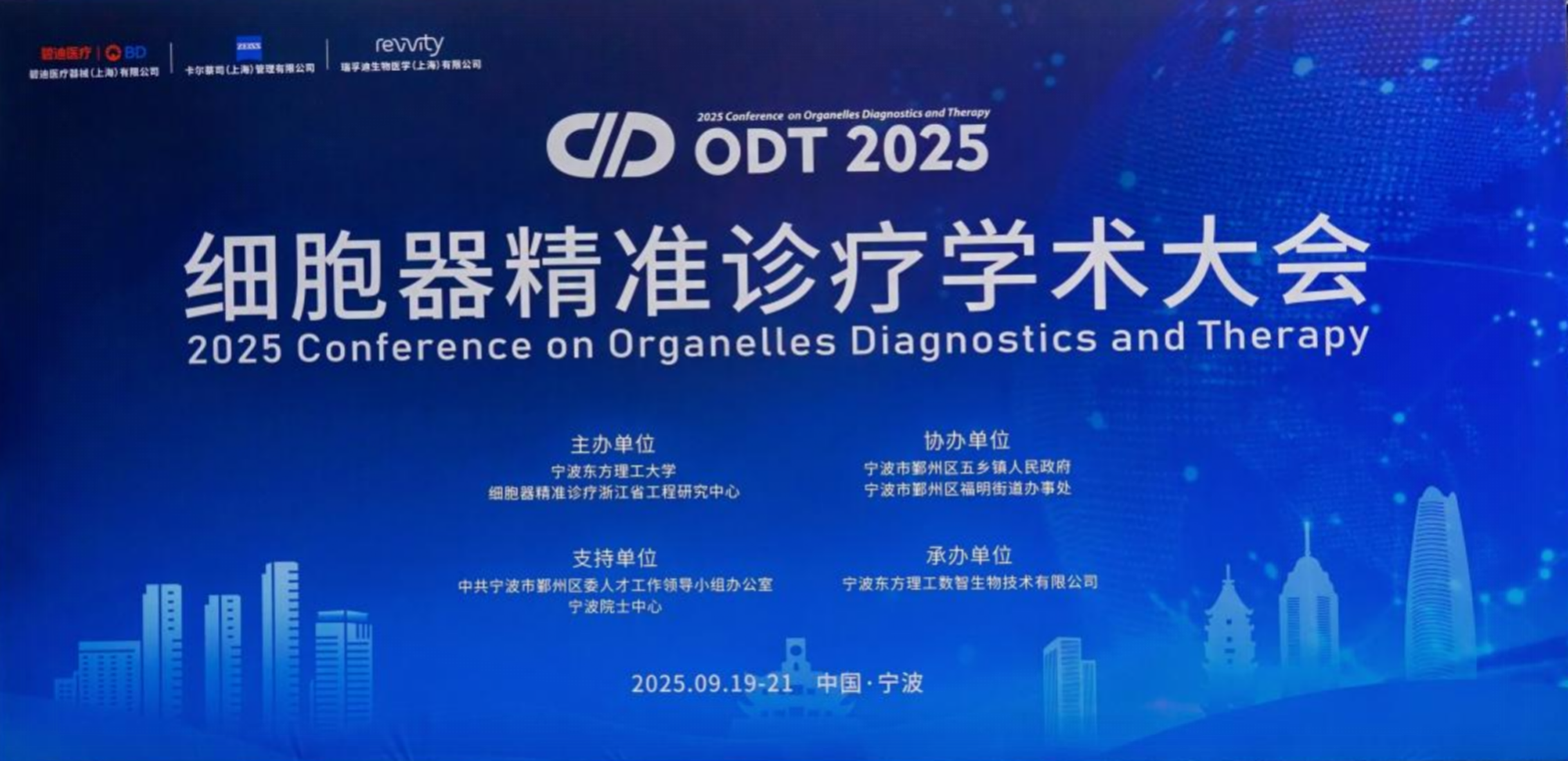
On 20–21 September 2025, the 2025 Academic Conference on Organelle-targeted Precision Diagnosis and Therapy, hosted by Eastern Institute of Technology, Ningbo, and the Zhejiang Engineering Research Center for Organelle Precision Diagnosis and Therapy, was held at the Ningbo Academician Center. Under the theme "Decoding Organelles: Opportunities and Challenges from Basic Discovery to Precision Medicine", the conference focused on frontier topics including organelle imaging, organelle interactions, antimicrobial resistance, drug screening and organoid intelligence, with the aim of building a high-level platform for academic exchange and collaborative innovation that links basic science, technology, the clinic and industry. Nearly 200 experts, scholars and representatives from universities, research institutes, hospitals and companies across industry, academia, research, medicine and investment gathered to discuss trends in the field and key technical paths. The conference was co-organized by the People's Government of Wuxiang Town and the Fuming Subdistrict Office of Yinzhou District, Ningbo, with strong support from the Talent Work Leading Group Office of the CPC Yinzhou District Committee and the Ningbo Academician Center, and sponsorship from three strategic partners: ZEISS, BD and Revvity. The conference opened with Research Professor Shihui Wen of Eastern Institute of Technology, Ningbo, as host. Jian'en Chen, Vice Mayor of Yinzhou District, Ningbo, spoke first on behalf of the district government, congratulating the organizers and welcoming the experts. He stressed the importance Yinzhou attaches to high-level science and innovation platforms and to the biopharmaceutical industry, and pledged to keep improving policies and services to support high-level academic exchange and industry–university–research collaboration, providing strong support for frontier research in life and health and the translation of its results. Dayong Jin, Fellow of the Australian Academy of Technological Sciences and Engineering and Chair Professor at Eastern Institute of Technology, Ningbo, spoke on behalf of the conference presidium. He praised Yinzhou's strong innovation ecosystem and vitality and introduced the distinguished guests. He said the conference was designed to pool cross-disciplinary expertise around the key challenges of taking organelle research from theory to practice, and to build an open, integrated and mutually reinforcing platform for exchange. He hoped that two days of in-depth discussion would spark new ideas and new collaborations and jointly advance breakthroughs in precision diagnosis and therapy and their clinical translation. In the keynote session, Professor Wenbo Bu of Fudan University delivered a talk titled "Reflections and Suggestions on Research Paradigms in Nanobiomedicine". He invited the audience to reflect critically on today's largely materials-driven research. Although nanomaterials have made remarkable progress in functional design and efficient chemical reactions from a materials perspective, he noted, from a biomedical perspective such research has yet to resolve fundamental bottlenecks such as elucidating disease mechanisms and improving the efficiency of targeted therapy; it particularly lacks the discovery of new biological mechanisms and remains far from clinical use. Building on this critique, Professor Bu described his group's systematic exploration of a new paradigm integrating medicine, science and engineering: a first stage focused on chemodynamic therapy and the new concept of "reductive damage", and a second stage that turned to a "metabolic reactivation" strategy and introduced the concept of "a biochemical family of targets", offering an original theoretical framework for target discovery and drug development. Academician Dayong Jin then gave a keynote titled "Progress and Reflections on Organelle Precision Diagnosis and Therapy". Starting from the history of microscopy, he reviewed how cell observation has progressed from the microscopic to super-resolution and from qualitative to quantitative, and presented his team's series of breakthroughs in live-cell imaging, organelle functional analysis and precision measurement. He highlighted how advanced imaging tools can reveal the dynamic behavior of organelles in disease, and how these mechanistic insights drive new diagnostic strategies and innovative therapies, providing strong technical support for future clinical practice. In the Organelle Imaging session, experts including Junle Qu of Shenzhen University, Peng Xi of Peking University, Lele Li of the National Center for Nanoscience and Technology, Dong Li of Tsinghua University and Kun Xu of Carl Zeiss gave outstanding talks on super-resolution technologies and their applications, examining the key role of spatiotemporal organelle imaging in basic research, disease diagnosis and therapy and offering the audience a rich program on multidimensional organelle imaging. In the Organelle Interactions session, experts including Si Ming Man of the Australian National University, Hao Wang of the National Center for Nanoscience and Technology, Binbin Ding of Guangzhou National Laboratory, Yusong Guo of The Hong Kong University of Science and Technology, Zhangsen Zhou of the Shanghai Institute of Nutrition and Health, Chinese Academy of Sciences, and Jichuan Qiu of Shandong University discussed key questions in organelle interactions. Their wide-ranging exchanges offered new ideas and methods for studying the mechanisms of organelle interactions and will help advance research in the field in China and abroad. In the session on Antimicrobial Resistance, Drug Screening and Disease Mechanisms, experts including Jinyao Liu of Shanghai Jiao Tong University, Fan Bai of Peking University, Zhiyin Song of Huazhong University of Science and Technology, Chen Jiang of Fudan University, Xin Ding of Sun Yat-sen University, Xiaowei Chen of Peking University, Jintao Liu of Tsinghua University, Jianhua Guo of the University of Queensland, Kuangshi Chen of Peking University, Lizhuang Liu of the Shanghai Advanced Research Institute, Chinese Academy of Sciences, Dijin Xu of Westlake University and Jing Qian, a technical expert at BD, shared frontier work and technical innovations from multiple angles. On the fundamental side, they dissected a range of cutting-edge biological mechanisms, offering new perspectives on life processes. On the applied side, research on antimicrobial resistance is becoming more diverse and precise, and new platforms for delivering biological drugs will make disease treatment more precisely targeted. The session showed the strength of interdisciplinary work: by integrating materials science, artificial intelligence, molecular biology and other fields, it offered a rich set of methods for tackling complex biomedical problems. In the Organoid Intelligence session, experts including Xinhua Lin of Fudan University, Liqun Chen of Tianjin University, Majid E. Warkiani of the Suzhou Institute for Advanced Research, University of Science and Technology of China, Zhisen Shen of Ningbo Medical Center Lihuili Hospital, Le Zhang of the University of Technology Sydney, Lin Han of Shandong University, Shaohua Ma of Tsinghua University, Xiao Zhi of Shanghai Jiao Tong University and Yongyu Xu of Revvity presented the latest advances in organoid research, which is becoming an important vehicle for drug discovery and personalized medicine. A closed loop from basic research to clinical application and translation has largely taken shape, supporting the high-quality development of precision medicine and biosafety. The parallel Forum on the Industrial Application and Development of Organelle Technologies built a bridge between industry, academia, research, medicine and investment. Tian Xia, Executive Dean of the Yinzhou (EIT) Digital Intelligence Bio-Innovation Institute, chaired the forum, which brought together well-known investors, industry experts and project founders. Jie Wu, Deputy General Manager of Shanghai Science and Technology Venture Capital Co., Ltd., gave a talk titled "Demand-Driven Translation, Innovation and Entrepreneurship in Biomedicine". Lively discussions covered the industrialization of organelle and biophotonics technologies, and five industry projects delivered pitches that showcased the innovation and commercial potential of organelle precision diagnosis and therapy. Kai Mao of the Development and Cooperation Department of the Yongjiang Science and Innovation Zone Office presented the zone's investment environment and policies, offering strong support for attracting projects and promoting industrial development. The successful 2025 Academic Conference on Organelle-targeted Precision Diagnosis and Therapy provided a platform for in-depth exchange and collaboration among researchers and practitioners in the field, reflecting the shared hope of the academic community to move basic research toward clinical application and promoting close integration of academia and industry. Participants agreed that organelle precision diagnosis and therapy, as an emerging interdisciplinary field, has broad prospects. With continued technological progress and innovation, it is expected to deliver more breakthroughs in disease prevention, diagnosis and treatment, and drug development, making greater contributions to human health. The hosts, including Eastern Institute of Technology, Ningbo, and the Zhejiang Engineering Research Center for Organelle Precision Diagnosis and Therapy, said they will continue to advance the field and hold more high-quality academic events. Guided by biomedical needs and supported by the deep integration of medicine and engineering, they aim to open new paths for biomedical innovation and help usher in the era of organelle precision diagnosis and therapy.